Why Mediation Often Wins Over Litigation

Mediation flips the script.
It transforms a "Me vs. You" situation into an "Us vs. The Problem" scenario.
1. You Retain Control
In litigation, a judge who doesn't know you or your family makes life-altering decisions based on rigid legal statutes. In mediation, you and the other party remain the decision-makers. You can create "outside the box" solutions that a court simply doesn't have the authority to grant.
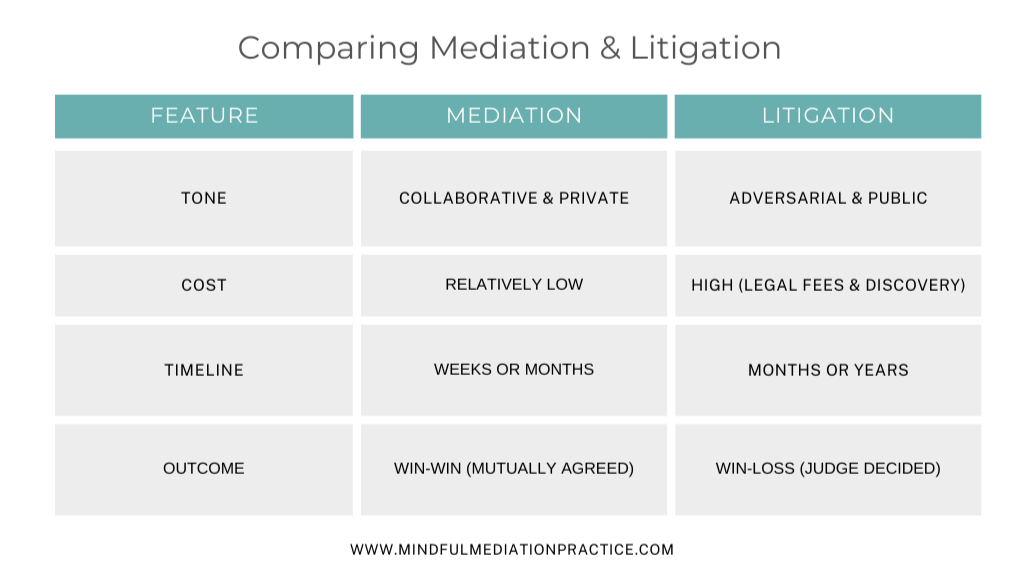
2. Significant Cost Savings
Litigation is notoriously expensive. Between retainers, hourly billing for two separate attorneys, and court fees, the costs can spiral into tens of thousands of dollars.
Mediation: You generally share the cost of one neutral professional.
Litigation: You pay for two sets of experts and the time spent on "legal combat."
3. Faster Resolution
The court system is often backed up for months, if not years. Mediation moves at your pace. If both parties are motivated to settle, a resolution can be reached in a few sessions rather than a few years.
4 Preservation of Relationships
Litigation is "adversarial" by design—it’s built to produce a winner and a loser. This often destroys any remaining goodwill. Mediation fosters communication and cooperation, which is vital if you need to co-parent or maintain a professional network after the dispute is settled.
The Professional Myth:
You don't have to give up your legal rights to mediate. You can still have an attorney review your final mediated agreement before you sign it. This gives you the best of both worlds: legal protection without the legal warfare.
Is Mediation Right for You?
Mediation works best when both parties are willing to come to the table in good faith. It transforms a "Me vs. You" situation into an "Us vs. The Problem" scenario.